
Meeting defensible space requirements
Wildland-Urban Interface (WUI) Requirements
The City of Louisville has adopted Wildland-Urban Interface (WUI) regulations to reduce wildfire risk and help protect lives, and property.
Why did Louisville adopt these requirements?
In 2023, the State of Colorado adopted legislation requiring local governments to implement wildfire resiliency standards. Louisville's WUI regulations meet and, in some cases, exceed the minimum state requirements.
Where do these requirements apply?
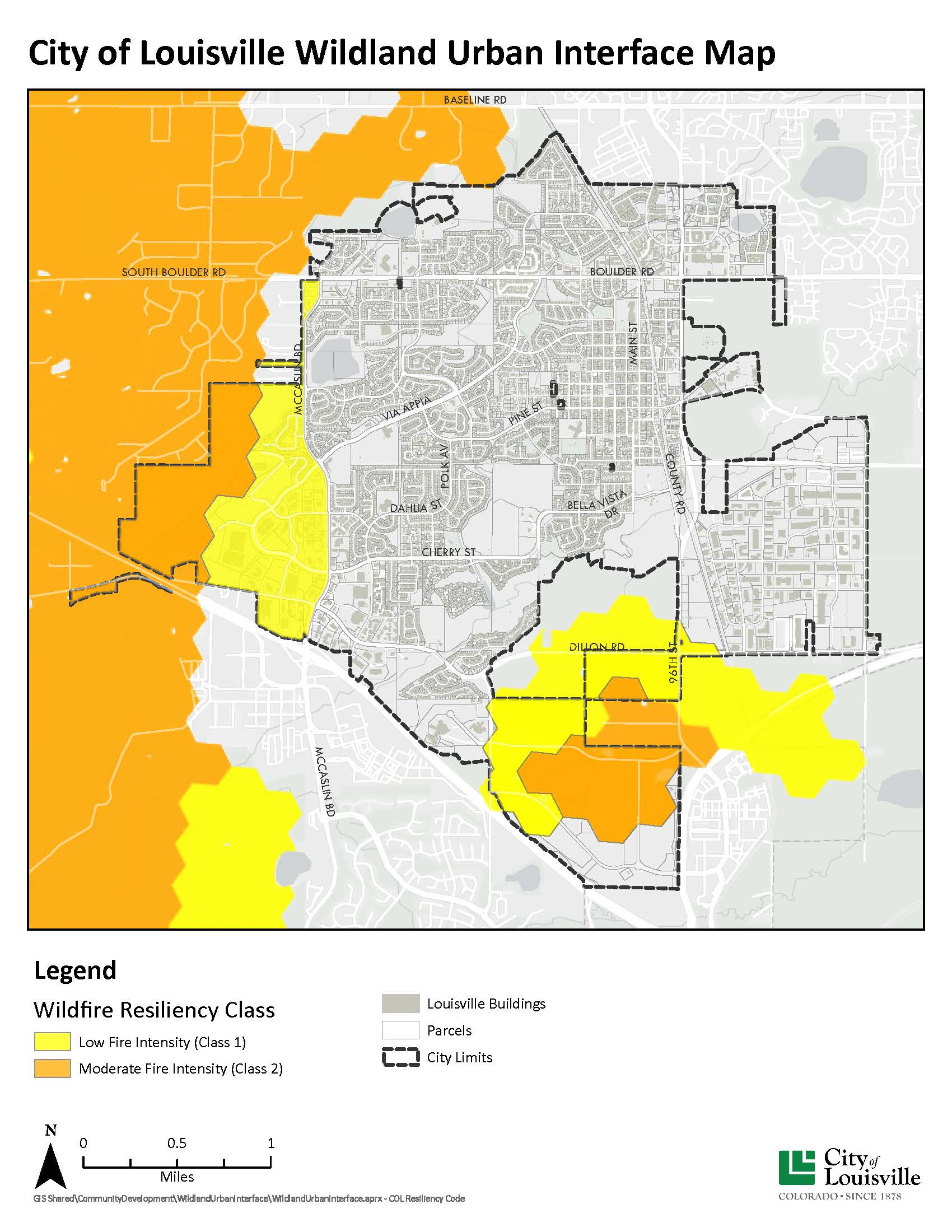
When do these requirements apply?
- New construction
- Building additions
- Maintenance activities covered by the code
- Changes in occupancy that create habitable or occupiable space
Existing legally constructed buildings generally may continue to be used without being fully retrofitted solely because the WUI Code was adopted.
Recent Wildfire Protection Code Amendments
|
Summary of Recent Wildfire Protection Code Amendments |
||
|
Code Amendment |
Summary |
More Information |
|
Fire Hardening / Juniper Prohibition – January 2026 |
Strengthened citywide fire-resistant building-material standards and prohibited new juniper plantings. |
[View Ordinance View Ordinance / LMC Chapter 15.70] |
|
Marshall Fire Rebuild Area Defensible Space – February 2026 |
Established special 0–5-foot Immediate Zone landscaping requirements for specified Marshall Fire rebuild areas. |
[View Ordinance / LMC §15.70.050] |
|
Wildland-Urban Interface Code – April 2026 |
Established the WUI Map and tiered Class 1 and Class 2 construction and defensible-space requirements within designated Wildfire Hazard Areas. |
[View Ordinance / LMC Chapter 15.80] |
|
Class B Composite Decking – 2026 |
Allows qualifying Class B composite decking and aligns the City's fire-hardening and WUI standards. |
[View Ordinance / LMC Chapter 15.70] |
Looking for a Specific WUI Requirement?
|
Topic |
General Requirement |
Code Reference |
|
Class 1 Requirements that Apply in all WUI Areas
|
||
|
Exterior Walls, Siding, Eaves & Projections |
Fire-resistant materials are required for exterior walls, siding, eaves, and projections. |
LMC §15.80.070.B.1 |
|
Decks |
Fire-resistant deck surfaces, steps, and guardrails are required. Qualifying Class B composite decking is allowed as an exception. Additional requirements apply below decks close to grade. |
LMC §15.80.070.B.2 |
|
Roofing |
Class A roofing and additional flame- and ember-protection measures are required. |
LMC §15.80.070.B.4 |
|
Gutters & Downspouts |
Noncombustible gutters and downspouts and protection against debris accumulation are required. |
LMC §15.80.070.B.5 |
|
Vents |
Attic, rafter, and underfloor vents must meet ember-resistance requirements. |
LMC §15.80.070.B.6 |
|
Immediate Zone: 0–5 Feet |
The area immediately around a structure must use noncombustible hard-surface ground cover; vegetation must not encroach into the zone, and surface fuels such as logs, branches, and slash must be removed. |
LMC §15.80.080.B.1 |
|
Retaining Walls |
Certain retaining walls near structures, supporting structures, or supporting required egress must be constructed of noncombustible materials. |
LMC §15.80.080.B.2 |
|
Fences |
Fencing within 8 feet of a regulated structure generally must be noncombustible or constructed of qualifying Class A materials. |
LMC §15.80.080.B.3 |
|
Addressing, Roads & Fire Protection Equipment |
Requirements address identification of roads and driveways, fire protection equipment and hydrants, and visible building addresses. |
LMC §15.80.080.B.4–6 |
|
Additional Class 2 Requirements – Moderate and High Fire Intensity Areas
|
||
|
Additional Building Requirements |
Properties in Moderate and High Fire Intensity areas must meet all Class 1 requirements plus additional standards for flashing, underfloor areas, windows and glazing, exterior doors, garage doors, and certain accessory structures. |
LMC §15.80.070.C |
|
Intermediate Zone: 5–30 Feet |
Additional vegetation-management requirements apply, including removal of hazardous vegetation and combustible surface fuels, tree pruning, separation of shrubs from tree branches, and mowing of dormant grasses and weeds. |
LMC §15.80.080.C.1 |
|
Expanded Zone: 30–100 Feet |
Minimum tree-crown spacing requirements apply. |
LMC §15.80.080.C.2 |
Need Help?
Not sure which requirements apply to your property or project?
Contact the Building Division: (303) 335-4584 or Building@LouisvilleCO.gov
Final WUI Map Ordinance No. 1918 Series 2026 With Approval Amendments View LMC Chapter 15.70 – Fire Hardening Code